Birmingham Zine Festival

Simon Fox Interview!

Tags: ,

3475731026 e19238ff7c m Simon Fox Interview!

I remember listening to Grover on John Peel as I did my homework as a kid – what caused the break-up?

That makes me feel pretty old! We didn’t really break up, just faded away. After 10 years, we’d pretty much achieved what we wanted to. None of us particular considered ‘Grover’ to be a viable career option! We’d released a number of records, did a Peel session and got a fair amount of radio play. We felt the band was getting a bit stale, so we went off and did our own things. Our original bass player, Andy Hall, had left after having completed our album ‘Tiny Blue Sparks’. Steve Hough joined on bass for gigs but we didn’t really write any new stuff after that. Steve and I put out a couple of records as experimental electronica project, ‘Krafla’. I worked with a singer called Clair Horton on her album, before embarking on my solo “career”. Steve and Si Rider, our drummer, went on to form ‘Einstellung’, who I’m a big fan of. We’re all still close friends and support each other’s stuff (except Steve doesn’t really like folk, so he takes the piss out of my banjo playing).

How long have you been making music? can you describe your first bands/songs?

As a kid, I played trombone and was in a swing band from about the age of 13. I bought myself a cheap guitar at 16 and joined a local band (which included Si from ‘Grover’) called ‘The Wimpletodes’. I still don’t know why they had such an awful name, but they were pretty good in a ‘Bunnymen’/'Mighty Lemon Drops’ kind of way.

The first band I formed was called ‘Sharon’ and we were sort of a shambolic hybrid of ‘Cud’, ‘The Fall’ and ‘Inspiral Carpets’. We got a reputation as a good live act, but were far too flaky to make much of it.

I joined local heroes ‘The Moneygods’ (again featuring Si) for a couple of years. The singer was Daz Hale, who is now a presenter on BBC WM!

Si and I finally decided we should form a band that reflected our love for more alternative stuff like ‘Sonic Youth’, ‘Stereolab’, ‘Dinosaur Jr’, etc. and that’s when ‘Grover’ was born.

Are there any musicians/artists which have left a long lasting impression upon you?  what is it about them that you found affecting?

My all time heroes don’t necessarily mirror the kind of music I make myself. I will always love Tom Waits and Captain Beefheart and my approach these days is informed by another idol of mine, Robert Wyatt. Closer to the stuff I do now, ‘Red House Painters’ and ‘Papa M’ have been a tremendous influence, and I spend a fair amount of time listening to classic folkies like John Renbourn and Bert Jansch. PJ Harvey, ‘Breeders’, ‘Throwing Muses’ and ‘Sebadoh’ all get an honourable mention and I still tend to put in a few more avant-garde elements into my music, which reflects this.

How involved are you in the local music scene? Which groups/musicians do you think people should keep an eye out for?

I guess I’m not as directly involved as I used to be when ‘Bearos Records’ was going strong. We used to help national and international acts get gigs in Brum in return for them giving us one, and this was fun. I still go to a lot of gigs (mainly ones put on by Capsule) and I’m involved with ‘Commercially Inviable’, a record label/collective based in Birmingham. I play in James Summerfield’s band when he asks.

I would say you should definitely watch out for ‘Gurdan Thomas’. It’ not entirely clear whether he’s a person, a band or a loose collective (non of them are actually called Gurdan Thomas…). He/they’ve just released an album on ‘Commercially Inviable’ and are making a real name for themselves, particularly on the continent – main man Ian divides his time between the UK and Bavaria. Gurdan’s stuff is very upbeat and inventive, and quite silly in a ‘Gorky’s Zygotic Mynci’ kind of way and they’re all great musicians.

Do you feel the death of John Peel 6 years ago, has had any affect on home-grown, independent music?

It was an incredible pleasure to have met Peel on a number of occasions, including playing host to him when he came to Brum in 2000 for ‘Music Live’. At the time, he was a one-man industry and pretty much the only mainstream outlet for bands like ‘Grover’ and our mates on other labels around the country. I think after the initial shock of his death, and for about a year or so afterwards, there was a gaping hole in the independent music scene. Huw Stephens and others took on the mantle to some extent, but it took a whole new station, BBC 6Music, to really provide some kind of effective replacement. On that level, I think it’s actually more healthy in that there are more shows and presenters willing to showcase new music. I know that Gideon Coe and Marc Riley have played my solo stuff, which is nice.

Online media have revolutionised the distribution of independent music, but I’m not sure whether it will really provide a practical career path for the majority of musicians. There’s simply too many outlets to choose from. I listen to 6Music most days and have discovered a lot of great new stuff as a result but, for me,  live music remains the main focus for discovering the real impressive stuff. ‘All Tomorrow’s Parties’ festival has been a wonderful development over the last 10 years and I go every year. Locally, Capsule have gone from strength to strength and their ‘Supersonic Festival’ is more or less the only thing that can hold a candle to ‘ATP’.

simonfox Simon Fox Interview!

Timothy Winchester Interview!

Tags: , ,

Header v 1 copy 300x150 Timothy Winchester Interview!

Timothy Winchester makes super cute comics featuring a whole array of cool characters- including some you will recognise from TV or your favourite movies! Lady Gaga, Twilight, the Scooby Gang and many more www.timothywinchester.com He will be appearing at BZF selling exciting things like comics and badges!
Thundercats Move COL copy 300x221 Timothy Winchester Interview!

1)      What classic novel would you be and why?

I wish I was something like ‘Lord of the Rings’ – all epic and full of elves and magic and popular and stuff. But knowing my luck, I’d probably be something depressing like ‘Return of the Native’ or ‘Wuthering Heights.’ Or something that no one reads until they need it – like a catalogue.

Actually, I suppose I could actually be my comics. Is that allowed even though they aren’t a classic novel? They are sad and funny and cute and involve a lot of crying – all things I hold dear to me.

MY FINAL ANSWER: I’d be my own comic (or a catalogue)

2) If you were shrunk to 2 inches tall where would you go to hide from creepy crawlies?

If I was shrunk to two inches tall, the first thing I would do is cry. A lot. I quite like being tall…and I don’t like a lot of things so being shrunk would make me sad. Another thing that makes me sad is creepy crawlies. There was a caterpillar on my pillow a few nights ago so I had to sleep without a pillow! And there was one time when a spider hid in my notebook!

So…I would have to hide somewhere super safe. If other people had been shrunk to two inches tall then I would ask them for advice. If they were not very useful or nice then I would dress up like an elf and convince a shoe maker to look after me. I’d outsource all the shoe making though.

MY FINAL ANSWER: I would hide with a shoe maker

Scooby Gang Jessica FIN 300x202 Timothy Winchester Interview!

3) What super power would you choose and what would you do?

I would love a super power and I often ask myself this question. But my answer always hinges on another question – does everyone else in the world have super powers, or is it just me? If everyone has super powers then I’d obviously have the super to copy any of the super powers I wanted. I’d be like a Swiss Army Knife of super powers…or a catalogue! That would be my superhero name – Catalogue!

But if I’m the only one with super powers then I suppose I’d want a different super power… but I can’t say what it is here.

MY FINAL ANSWER: I can’t tell you. Sorry. Maybe I’ll make a comic about it?

4) If you were a board game which one would you be and why?

Hahahaha. Board games and I are pretty much BFFs. Choosing which one to be would depend on my mood. If I was happy then it would be The Game of Life – because life is normally better if you’re happy (until you get taxed or have twins). If I was sad then I’d probably play Scrabble because it makes me feel stupid – so I could forget how sad I was. Oh – and you can’t forget Hungry Hippos! Or Cludo! Hearthrob! Pop Up Pirate! Twister! Naked Twister! BFF Twister! LOL Twister! Pancake Twister! So much Twister.

MY FINAL ANSWER: Right now, I would like to be Hungry Hippos because I’m hungry. But normally I wouldn’t be able to choose.

5) Which Big Brother contestant (from any series) would you kill and for what reason?

Oh no! I wouldn’t kill anybody! That’s a terrible thing to do! If I didn’t like someone then I’d make a comic about it…but I’m a coward so I’d probably just change their name and draw them as a big green blob (like here: http://timothywinchester.blogspot.com/2010/08/real-life-call-me.html). But I do watch Big Brother so here are the contestants that upset me.

In no particular order:

Everyone that isn’t Aisleyne.

Only kidding! Aisleyne is probably my Number One Contestant…but listing the ones I don’t like would take ages. So I won’t bother. But Aisleyne FTW! Know yourself!

MY FINAL ANSWER: I’m too nice to say anything mean but I really liked Aisleyne so she would win a prize.

True Stories Haircut COL copy 300x228 Timothy Winchester Interview!

TAGS: None

Interview of James Nash by Hannah Davis

James Nash is the designer of the wonderful Birmingham Zine Festival logo and Poster. Please see his website for more of his artwork: http://www.jamesnashlovesyou.com

  1. Your website says that you have been making a comic as a diary every day since your final year of University. How did you manage to make comics so frequently – did it naturally become a habit, or did you purposefully get yourself into this routine?

Yes. It was a project that I started at Brighton, partly in response to research I’d been doing about comic imagery as a subjective linguistic device, like, testing that theory by making everyday nothings into something readable and building narratives.

And partly, being embroiled in such a puritanically graphic, concept driven course, it was freeing to build a neat framework in which I could just write and draw without questioning what I was doing too much, as that can become creatively crippling and had previously stopped me drawing altogether.

Its been maybe about 6 years since I started it – originally it was great to test myself and produce something on a daily basis as it wrings out things you don’t know are there and that aren’t preconceived. I’ve had loads of blips in the ups and downs of the past few years – I’ve got a whole years worth of stuff that was so lazy and abject that I’ve never shown anybody. I’ve cheated a lot of times, but now doing it exactly on the day doesn’t feel as important as just having something for that day.

2. What inspired you to publish your own diaries, and why did you decide to do this in comic form?

Er, see above mostly, in terms of why I make it as a comic, the visual idea… In terms of the material and content, it is an attempt at mapping and representing life; all the good, bad, boring, exciting, happy, sad things within a structure that gives all those things equal space and consideration.

Self publishing comics is a great way of gauging an immediate and personal response from an audience. Just to know that the original idea works; that people read, engage and respond to it in such a manner is incredibly rewarding.

3. Do you always write about real life and / or your own life? (are any of your characters based on people in your life?)

Yes. It can be problematic. Mostly people love the thought of being notable enough to be included, but are guaranteed to hate anything you write about them, or the manner in which their personality is editorialised.

4. What is your favourite comic?

Woah. Difficult. I’m pretty sure its Teratoid Heights by Matt Brinkman. I also love anything by Ron Rege Jr. There’s a short story by Gabrielle Bell I love called Cecil and Jordan in New York, I think she made it into a film with Michel Gondry, but I’ve not seen it…

5. Your most recent work is called ‘Speaking of Not Knowing’. Please tell us more about this and how your decided on the title.

All the titles for my comics are just quotes the comic itself, its one of my little rules and usually its something that encapsulates the theme of the year. Speaking of Not Knowing fitted the theme of getting past bad times, about working out and rationalising things that you can’t just know, it was also just linguistically neat.

6. Do you generally stick to the same style and process when you draw and create your comics?; what materials do you tend to use?

I use a brush and ink. I don’t plan in pencil or anything. It has more purpose and is a good expressive line. I also believe that the mark you make, the mistakes you make, are all important. It seems like a perverse idea to draw something and deny the way that you made it.

7. What, and who, inspires you the most in your creating and making?

Gary Panter, his approach to working more than anything. And Coronation Street.

8. What is your favourite location and time of the day for drawing?

It used to be whenever I could get time, but recently I’ve been a lot more free; So rather than falling asleep on my sketchbook at 1 or 2am, tired and bitter and hateful, its now mid-morning at the kitchen table. More specifically, weekend lunchtimes listening to the football on the radio with a lovely cup of tea.

9. If you weren’t an illustrator and Comic Artist, what would you like to be doing instead?

No idea, I’ve been working in consistently horrible jobs since leaving college, in a bank, bar, office or whatever. There have been plenty of times where I’ve thought that was it for me, it could still be.

10. What would you rather be [and why]; A withered daisy, a coffee-soaked comic, or a pair of ripped jeans?

A withered daisy. It’s a rough situation, but you’re still a flower.

John Allison Interview

Tags: ,

rrh1 cols 300x212 John Allison Interview
I (John Allison) have been making comics on the Internet since 1998, my series Scary Go Round ran for seven years, spawned ten modestly successful self-published books, and has been read by hundreds of thousands of nosey parkers. My new series Bad Machinery started in 2009 and is about two warring factions of Nancy Drew/Hardy Boys style child detectives at the same school. You can read all my comics at scarygoround.com or see my more marginal ideas on my blog at sgrblog.blogspot.com

1) If you were a ghost- what famous person would you haunt and why?
As the author of an internationally popular comic, I would haunt the inventor of the world wide web, Tim Berners-Lee, really just to thank him for allowing people to visit scarygoround.com and read my work. While haunting is not completely pleasant, I like to think he will take the visitations in the “spirit” they were intended! Ha ha!

Why does your first question require me to die?

2) What song makes you get up and dance?
I’m not a dancing man, I’m 33, my dancing days are behind me. Dancing is for the young. Perhaps I would join in a waltz, but nothing as enervating as a foxtrot or charleston. Back in my bogling days I might have shaken a tailfeather to “That’s What I Call A Show” by the Don Mathers Jazz Combo.

3) What story about yourself would you like to read in the paper?
“Local man becomes modestly wealthy in a manner he is able to maintain for the rest of his life with a mere modicum of effort”.

4) What would your immortal last words be?
Now you have tied yourself up in knots here. Someone immortal doesn’t really have last words. They can decide not to speak, but ultimately, they could cough out a phrase a couple of millennia later. My mortal last words will be “sliding down a long bannister, naked, covered in goose grease is not as dangerous as meddling bureaucracy would have you believe”.

5) If you had to side with night or day in a fight who would you choose and what would you do to help it win?
Christ alive, you side with day! You can always throw a blanket over someone who gets sick of the sun, but a chronic vitamin D deficiency is no fun at all. To help the day win, I would ban such products as Night Nurse, Knight Rider, Knight & Day (starring Diaz and Cruise) and Horlicks.

20100317 300x212 John Allison Interview

Get A Grip

TAGS: None

Get A Grip will be hosting a screen printing workshop at VAAD (Custard Factory) at 6:30pm, Saturday 11th September as part of Birmingham Zine Festival.They will also be selling copies of their fanzine DIY Times at the Zine fair at The Victoria during the day.

Founded in November 2009 GET A GRIP Studios is a screenprinting business run by Kay and Sam and is based at The Custard Factory which started from a combination of DIY ethics, ecological thinking and a mutual love of Punk Rock. They specialise in screenprinting merchandise using water based inks. [...]

Founded in November 2009 GET A GRIP Studios is a screenprinting business run by Kay and Sam and is based at The Custard Factory which started from a combination of DIY ethics, ecological thinking and a mutual love of Punk Rock. They specialise in screenprinting merchandise using water based inks. Recent clients have included the bands CavesCrazy ArmBangersTall Ships, The Arteries,Superpowerless, Wolverhampton City Council and artists Kate Wilson and Mr Millerchip.

We asked Kay and Sam to tell us a bit more about GET A GRIP.

How did GET A GRIP studios come about?

GET A GRIP is the culmination of hanging around the Custard Factory, a couple of beers together and turning up at the same Punk-Rock shows over a period of a few months last year. I had my shop (shared with Mouldy Loaf) but was printing T-shirts in my parents’ garage. Sam had a large studio and lots of equipment, but was finding that running a screen printing business on his own was getting tiring. It started out as a ‘let’s see how it goes’ kind of thing, and now it’s going pretty well.

4398431966 6904014f71 Get A Grip

How long have you been screenprinting? How did you get into screenprinting in the first place?

I can remember screen printing as a kid at summer clubs and stuff, but graduated from University College Falmouth in 2008 with a degree in textile design, where I specialised in print. Sam came to it from a totally different angle. After getting annoyed with other business’ messing up his print orders, he decided if they can’t do it how he wants, he should. True DIY ethics.

Why choose screenprinting over other forms?

I think for me it’s how hands-on the process is; from exposing the screens to mixing the inks, we’re not relying on machinery for much of it. At University, digital print didn’t do anything for me – sitting on Photoshop for days at a time then pressing a button to see it roll out the printer. It just doesn’t have the same tactile qualities, like the way every print will be slightly different. Screen print was developed as a form of mass-producing stuff cheaply, yet it’s got a place in the history of art and music, which really appeals to me, and I want to be part of it.

What items do you print?

We mostly print T-shirts, tote bags, hoodies and paperstock, but to be honest, we’re always willing to try something new! We’ve printed record sleeves and have just ordered a load of koozies to print, which have had a lot of interest.

What are you currently working on?

So far this week, we have tote bags that will be going into the Created In Birmingham shop in the Bullring shopping centre, T-shirts for a band who are touring around the UK next week and an order coming in from Wolverhampton Art Gallery. It’s pretty cool – week to week you never really know who or what you will be printing for. In the studio we are working towards producing a zine about business’ and other people with DIY ethics around the UK with our friends No Guts No Glory – an independent design agency and shop in Exeter. The DIY ethic is all about sharing knowledge and maintaining a sense of community, which is something I really believe in. We wanted to do something where we could share our personal experiences of self-employment with other like-minded people. We hope that readers learn a few things and are inspired to get involved rather than sitting around waiting for someone else to come along and put on a show, write a blog, produce a magazine, open a shop, start a collective, or a million other things.

Who have your clients been so far?

I like to think that we sit in-between the art world and the music world; two things I am really passionate about. Whether it’s a band T-shirt designed by an awesome illustrator, a print which is going to end up in an art gallery, a clothing label, or even someone wanting T-shirts for a hen night, it’s all good. We print for a lot of bands, including Crazy Arm who will be touring around Europe next month with Frank Turner. Illustrators we have printed for include Mister Millerchip and Marcroy Smith, and we have also printed posters for nights at The Victoria and gigs happening nationwide. We keep a record of who we have printed for and what not on our blog. It’s nice to see how it’s built up over the 4 months we’ve been going.

4397660945 3cb06fcfc5 Get A Grip

What’s been your favourite project that you’ve worked on so far?

Printing all the GET A GRIP sample merchandise and promotional stuff has been a lot of fun. We love the artwork illustrations Lee Nutland has done for us, so it’s great to see it screen printed rather than just pixels on the website. Getting the right image for GET A GRIP was real important for us, so Lee’s artwork has been brilliant for capturing what we are.

Can you describe your studio set up?

We have three and a half drafty rooms in a dark corner of The Custard Factory. The largest room is home to a six-colour carousel for printing garments, a vacuum press for flatstock and a beast of a tunnel drier. The office is where we spend time sat by the one heater in the place – sorting out artwork, replying to e-mails, drinking copious amounts of tea and mocking each other. We then have a dark room with an exposure unit for making the screens and a wet room/kitchen armed with a pressure washer for washing ink out of the screens or reclaiming them so that they can be used again and again. Sam has made most of the stuff by hand, such as the exposure unit and wash-out booth, as well as all the desk space in the office. Any excuse to get out a power tool and he is on it.

What inks and materials do you use?

We only print using water-based inks. They are 100% solvent free and environmentally friendly. We print onto a range of different garments and materials, but we will always push the environmentally friendly or more ethical option first, such as EarthPositive T-shirts and 100% recycled paper stock. Knowing a lot of people in bands and running our own personal clothing labels means we understand how budget vs quality works, and we are always going to make sure the customer get the best out of their budget.

What parts of the screen printing process do you like/dislike the most?

No one ever wants to reclaim the screens. It’s fun using the pressure washer for about 30 seconds… 10 screens later, your arms ache and you are soaking wet from head to toe. Printing is, of course, the best part – it can be hard work but seeing the items printed and coming out of the tunnel drier is a good feeling, no-matter how tedious the job. Being paid is also pretty nice too, though in most cases we sacrifice paying ourselves anything in order to make GET A GRIP better. We’re still a very young business after all.

What would be a normal size run for you? What’s the biggest run you’ve done so far?

50 T-shirts is about the average order we get, which is quick and fairly straightforward to turnaround. The largest print job we have had to date was 300 4-colour tote bags. This was killer because I’d been ill and had come out of a bout in hospital the weekend before – we started the job at 3pm and finished at 3am (we had a pizza break but no beer). It was our own fault for not being on top of time management, and I’ve definitely learnt from that. I think Sam would happily work day and night if he could though – he’s like a printing machine.

4397662939 e1bff869fa Get A Grip

Do you have any ecological/ethical practices i.e. using environmentally friendly inks or refusing clients if they wanted something printing that went against your priniciples.

We rarely turn down work, and usually it is because the client is asking for something we simply cannot print because of using water-based inks, such as vinyl stickers. To be honest we haven’t been asked to print something against our principles so I couldn’t say, though Sam has just pointed out that we would turn down a job such as printing pro BNP shirts (for example), so I guess we would.

What would be your ideal project to work on?

This is hard. I would love the challenge of printing a lot of merchandise for a festival or something. To get involved with something like Supersonic would be amazing, particularly as it is on our doorstep and bands would be able to pick up their order at our studio over the festival weekend. We also like the idea of putting on our own shows, and also combining an exhibition of prints we have done – getting bands who we print for to play, as well as doing some screen printing so that people can have a go. We’ve looked into doing workshops, and also to move into a premises where we can have a shop front for people to visit, and where we can sell things produced in the studio. But at the moment we’re in no rush. We’ve got a long way to go and we plan on sticking around for a while.

What advice would you give any one who was interested in getting started in screenprinting?

I have printed in a garage and know people who print in their bedrooms – all you need is a bit of space and some creative thinking. It’s messy and you need a lot of patience, but there is so much scope for doing stuff and it’s pretty exciting when something comes out looking awesome. Read books, look on the internet, ask people who print if they can help to teach you, and don’t expect it to turn out perfect first time. And if you can’t be bothered with all the fuss – get us to print it!

For  more details on how to sign up for the screenprinting workshop or to get hold of their zine or indeed if you want any screenprinting done check out the links below

http://www.getagripstudio.com/

http://getagripstudio.wordpress.com/

Originally posted on http://thisishappening.co.uk

Carla Smith

TAGS: None

How did you get into illustration?
When I left school I went straight to the Birmingham Institute of Art and Design rather than taking A Levels because I knew that I wanted to do creative stuff from the off. After my B-Tec there I decided that I wasn’t quite dedicated/ patient enough to become a photographer which had been my original plan. Illustration leaped out at me as a degree to do because I’ve always been one of those people that draw all the time when I should be doing something else and it offered me the luxury of being able to do just that for 3 years. I loved it so much that I carried on doing it after graduating.
.
Kookykoala seems a fitting name. Where did your fascination with quirky animals come from?

I’ve always been a bit of an animal person, when I was growing up we had a LOT of pets and it felt a bit like growing up in a zoo at times. It seemed appropriate there was an animal whose name sounded similar to my own and I also think that koalas are pretty cool creatures! A couple of years ago I had a part time job being a professional dog walker and that definitely inspired some of it too.
.
What inspires you and your creatures?

Although it may not appear to be the case I’m really inspired by a lot of Japanese illustrators like Yoshimoto Nara, the animal ears on semi-human characters that recurs in my work was inspired by the girls with cat ears and babies wearing rabbit suits that I’ve seen in some Japanese drawings. I’m also really inspired by vintage illustrations of dogs. I Especially love the ones by Cecil Aldin which were drawn in Victorian times but also other animal illustrations that came about in the 1920s/ 30s.
.
Can you tell us more about what you will be exhibting at the Birmingham zine festival?

It’ll be a mix of some of the stuff I’ve been working on over the past year or so. There will be some collage stuff and some straight illustrations plus a bit of writing. Basically a glimpse into some of the oddness that goes on in my mind.
.
There is mention of a childs book, can you briefly explain what will be happening in this?

This is a plan I have but am still working out the finer details of at the moment I’m afraid!
.
What are your plans for the future?

To set up an online shop on my website and get myself an Etsy ooh and getting something printed by Threadless tshirts if possible! I’m looking into getting some of my designs printed onto bags so that my characters can become animated and go shopping with people.

T-Shirt Printing Workshop with Get A Grip

TAGS: None

Get A Grip Logo resized2 T Shirt Printing Workshop with Get A Grip

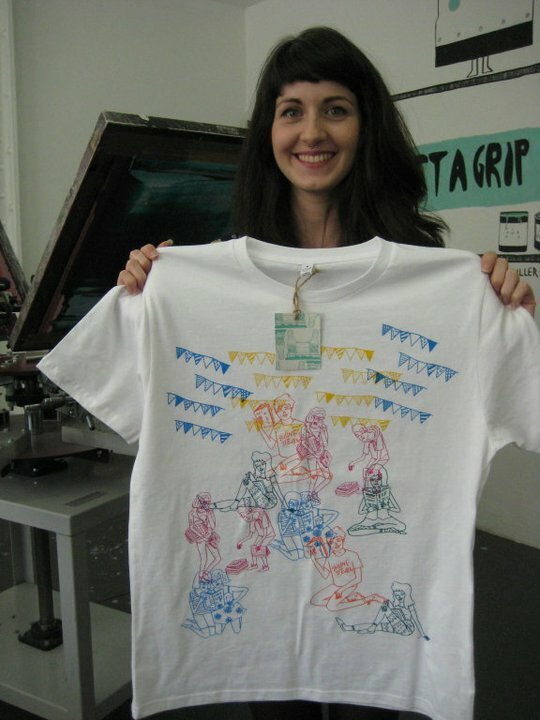
As part of Birmingham Zine Festival, we are offering you the chance to come behind the scenes of GET A GRIP to print your own T-shirt at our workshop.

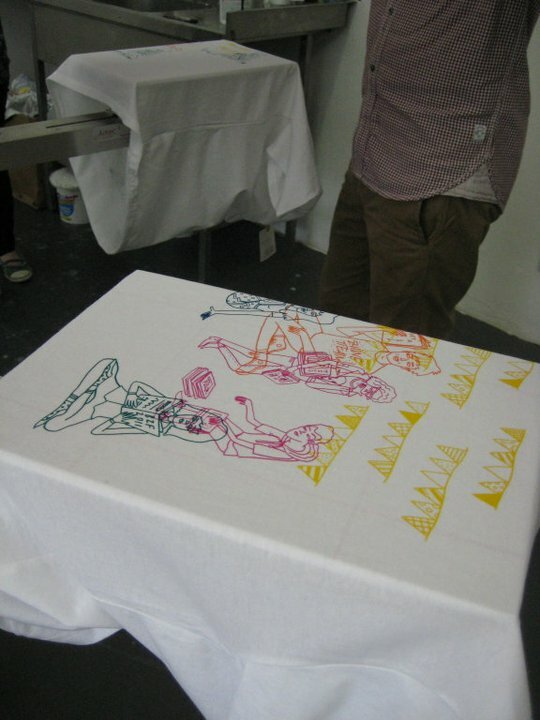
Over two hours you will print your own multi-coloured print using original images by the festival’s posterboy James Nash on our six colour carousel. After which, will end up with a totally unique T-shirt by choosing the placement and positioning of each separate image as you print to build up a design.

The workshop will be £20 per person and includes an organic 100% cotton EarthPositive T-shirt to print on with non-toxic waterbased inks.

The workshop will be held in our studio at The Custard Factory at 6.30pm Saturday 11th September, with an extra workshop on Friday 10th September subject to demand.

It’s open to all abilities- you don’t need to have printed before, and there will be an introduction into the screen printing process at the start.

To sign up please email you name and required T-shirt size (from ladies small to mens 2XL) to workshop@getagripstudio.com. Payment for the workshop will need to be upfront due to the limited spaces available.

Words and images courtesy of Kay from Get A Grip.

Get A Grip Photo resized T Shirt Printing Workshop with Get A Grip

Joe List interview

TAGS: None

freakleap 211x300 Joe List interview
..
When was it you discovered your fascination with comics and zines?
When I was a small man I read the Beano every week. It’s not the best comic by any standard, but it was cheap and accessible. I rediscovered comics when i went to college in Northwich. There is a lovely little shop there called Millennium Comics. The owner Dan steered my young mind towards Tony Millionaire, Peter Bagge and Daniel Clowes books.
….
Can you tell us a little more about ‘Freak Leap’ your most recent comic book?
I put Freak Leap together late last year, it started out as a bunch of stories I’d drawn up in sketchbooks. There are four short adventures and some little strips. People seem to like it.
The characters remind me of potatoes. Are they potatoes, and if so what is your favourite type of cooked potato? Roasted, baked, fried.. etc. If it is not a potato then it also reminds me of an egg. What is your favourite format for such foods?
Thanks. No, most of my characters have feature potatoes sadly lack. But I do like eating potatoes. Here are my top 5 methods of potato preparation (1= high 5= low):
1. Roasted
2. Mashed
3. Wedges
4. Baked
5. Chipped
In every case, the application of heat essential.
What is your favourite colour?
Blimp Brown
..
What are your motivations with your work? I notice there is a lot of humour. Is this especially important?
I like telling half jokes, ideas that aren’t quite finished. That’s what makes me laugh and so that’s what I try to convey in my comics.
..
In the annotated weekender, you take to mini illustrations and doodling on the guardians Weekend magazine. What is it that possesses the characters you draw and how do you feel about using existing material.
I like to think that my drawings are possessed by the spirit of 5th vice-president of the United States, Elbridge Gerry. It can be very enjoyable and challenging. A lot of decisions are made for you, but you have to work around the other images and text.
..
What inspires you, makes you tick, makes you dance, makes you sick?
Inspires: Science, Tony Benn
Tick: Tax return forms,
Dance: Janelle Monáe, The Ramones
Sick: Philip Hammond MP (face and political views)
..
If someone were to do a swap with you for a comic, what would you like in exchange?
I accept the following:
A comic of equal value,
A few choice coins,
A signed Clash LP,
Maximum diamonds,
.
I find that when I’m on the phone I doodle relentlessly. Does this also apply to you? When is it you find the best time to illustrate?

Everyone doodles on the phone, it’s therapeutic. The best time to Illustrate is when you have time too. I draw a lot when I’m riding the trains.
.
What can we expect from you in the future?
I’ve illustrated a book that will be coming out later this year. Also more comics; webcomics and printed comics. All the comics.

Liam Clark Interview

TAGS: None

The submissions for the Postcards: Mail Art Exhibition are rolling in! One of the first to arrive was by Liam Clark, an artist and full-time student from Ipswich. Liam is currently studying Fine Art at Norwich University College of the Arts and is a keen skateboarder and zine-maker in his spare time.

What was the idea or inspiration behind the artwork you submitted to the postcards exhibition?

The inspiration behind the artwork I submitted to the postcard exhibition comes from watching people in various places, I walk or skate everywhere so I see a lot of people and places others wouldn’t, simply because they pass right by them. I’m interested in how everyone looks different and I’m especially attracted to the odd looking people. The people in this piece, like in a lot of my work, are made up characters but based around different people I have seen and thought looked interesting.

As you’re creating these characters, do you also invent stories and personalities for them? Or are you just looking to make something that is visually interesting?

At the moment they are purely visual, although I have thought about creating lives for them. Just based on what some of the characters look like I could imagine they do certain jobs, or live in a particular house. I think I will end up creating an entire world with my characters, maybe even make a zine with a story line.

Have you ever done mail art before? Why did you want to take part in the project?

I decided to take part in this project because it seemed like a great way to display my work amongst many other artists in a zine festival, which is where I think my work is best suited. I also liked the idea of everyone’s postcards being swapped so you get a piece of someone else’s work at the end. I have attempted to do mail art projects before, such as participating in an art exchange, but it wasn’t very successful.

That sounds rather ominous! What went wrong? Maybe you can help us avoid making a similar mistake!

The art exchange was a good idea, the only problem with it was that is was based around a chain email where people were meant to pass it on to 5 different people so the exchange kept growing, but I think most people ignore those emails.

Ah, okay! We’ve avoided that pitfall at least! Your portfolio contains drawings, paintings, photographs and prints. What’s your preferred method of working?

At the moment I am mainly painting and drawing although I have a few ideas for prints I want to make, but I’m waiting until I’m back in uni so I can use their print rooms. I haven’t been able to do much photography recently as my camera is broken.

You’re also involved in publishing zines. How did you become interested in zines and what made you decide to create your own?

I became interested in zines during my foundation year, some of my friends were doing illustration and started a collective called 717 and began producing zines, which I thought were really great, so when I left I started to make my own skate photography zine called perspectives. I thought I’d just do that for the summer until I started uni but I found it really fun, so within the first few weeks of uni myself and two friends, Guy Jarrett and Rob Freimuller, created the 0nineHUNDRED collective and began making our own zines.

On your blog, you describe ‘Perspectives’ as “…a world that consists of much more than just doing tricks. Via a collection of photographs you can see the side of a lifestyle like no other.” How has your skateboarder lifestyle influenced you as an artist?

This answer could be slightly elongated as I recently wrote a whole essay on skateboarding and art. I think skateboarding is what made me become interested in art in the first place, simply in the graphics and introducing me to a lot of artists, but as I’ve became more and more interested in doing art I realised the creativity of skateboarding. It completely changes the way you look at the world, it means I travel through the city at street level, and not just in a car, so you see different things, you’re always on the lookout for an opportunity to skate, and now I’m always looking for something to draw, or take a photo of.

What other projects are you currently working on?

Currently I am working on a few zines which should be completed around October (when I get back to uni) ready for a show with the collective I am in, which is called 0nineHUNDRED. I am also working on a large series of small paintings, as well as sorting out my blogs and shop so that I can start selling zines and work online.

The Postcards: Mail Art Exhibition will take place throughout September at The Custard Factory. Liam Clark will also be supplying a few zines to our communal table at the zine fair on Saturday 11th September at The Victoria. See our events page for further details.

To view Liam’s artwork, go to www.liamashleyclark.tumblr.com

Teal Triggs Interview

Tags: ,

fanzines 213x300 Teal Triggs Interview

Teal Triggs is Professor of Graphic Design at the University of the Arts, London.  She is also the author of ‘The Typographical Experiment:  Radical Innovation in Contemporary Type Design’ and co author of ‘Beyond Critical Radar: Fanzines and Alternative Comics from 1976 to Now’. Her latest book ‘Fanzines’ is a study of fanzines from a historical viewpoint. It also aims to celebrate the visual qualities of fanzines. As well as taking an interest in fanzines academically Teal Triggs has a personal passion for the subject as she is an avid collector of zines.

We at The Birmingham Zine Festival obviously love anything zine related so we took the opportunity to quiz Teal about her forthcoming book.

Can you give us a brief description of your new book?

‘Fanzines’ is written from a collector’s perspective and provides a historical and visual overview of amateur magazines from the 1930s to present day. The zines are produced by fans passionate about their subjects ranging from science-fiction, punk and comics to thrift shopping, riot grrrls and celebrity culture.

How did you get interested in fanzines in the first place, what sparked your interest?

I grew up in Austin, Texas where there is a well-established music and counter-culture scene, with all the graphic ephemera that goes along with this – flyers, broadsheets and zines.

My dad was also a designer and academic, so there always seemed to be stacks of 1970s underground magazines and broadsheets laying around the house which from a design perspective, were visually amazing.

Cut-n-paste punk zines also emerged while I was at University as a design student and we all thought these were really novel forms of graphic design. It wasn’t long after this that I started collecting zines and valuing them not only from a design standpoint, but also in what their producers had to say about particular moments in time.

How does your new book ‘Fanzines’ differ from your previous book on the subject ‘Below Critical Radar’?

‘Below Critical Radar’ was a co-edited book with Roger Sabin and we decided to look specifically at the relationship between comics and fanzines. Other contributors provided insights into the themed areas of consumerism, horror, and the then new electronic publications. Obviously there is some overlap, but my new book focuses specifically on the history of fanzines, and celebrates their visual qualities.

What are your favourite fanzines and why?

This is an unfair question! With so many different kinds of zines out there and so many different authorial points of view, it is hard to choose a favourite handful. But if I had to say, I have a strong interest in feminism, so a lot of my collection is focused on early feminist and the more recent riot grrrl fanzines. There is such an honesty and passion to what these women are writing about as well as a playfulness in how they design their publications. What’s not to like about them?

If you were to make a zine today what would it be called and what would it be about?

I have been thinking about doing an online meta-zine called Zine Weekly. My thinking is that I could review zines and publish interviews with producers who are doing interesting things. I don’t think I could produce an actual zine per se as there are so many wonderful zines already out there worth reading.

Why do you think print zines still remain popular today?

Print zines are enjoying a flurry of activity. You are getting zine producers exploring letterpress and printmaking alongside the photocopied (or even risograph) production methods. I think the popularity has to do with a couple of things: the recent craft DIY revival, the tactility offered up by the production methods, plus the fact zines are homemade by someone who shares similar interests to you!

What role do you feel print zines play in an age where everyone can twitter/tumblr/blog?

Zines still play a key role in bringing people together – just look at the number of zine festivals taking place and how many people are actually attending these events. This may sound nostalgic, but print zines are still the visible evidence of a kind of human interaction – from the maker to the reader.  Or, as the author Frederick Wertham suggested, zines are  ’a novel form of communication’.

What do you see as the future of self-publishing?

I firmly believe that self-publishing will continue to exist in one form or another – especially as new technologies are allowing individuals to become be self-sufficient as authors, designers and publishers. For example, I have been thinking of what a zine would be like if designed for the iPad. We are already seeing barcodes embedded in mainstream magazines which when scanned provide another layer of information.  I could see the possibility for much more interactive narratives which maintain a zine attitude but with the sophisticated use of new forms of storytelling. I think the future of self-publishing is really exciting!

‘Fanzines’ By Teal Triggs is published by Thames &  Hudson on 20th September 2010. For further information go to http://www.thamesandhudson.com

© 2009 Birmingham Zine Festival. All Rights Reserved.

This blog is powered by the Wordpress.